The CARES Act 30-Day Notice Requirement:
Why It’s Still Causing Confusion—and Controversy
Few issues in landlord-tenant law today are as misunderstood—and politically charged—as the CARES Act’s 30-day notice to vacate requirement. What began as an emergency COVID-19 protection in 2020 has evolved into a lingering federal mandate that continues to impact eviction proceedings across the country. Now, with recent federal rollbacks and industry advocacy campaigns calling to “stop enforcement,” many landlords are left asking a simple question: Is this rule still in effect or not?
The answer, frustratingly, is: yes—and no.
The Origin: A Pandemic-Era Protection That Never Expired
The Coronavirus Aid, Relief, and Economic Security (CARES) Act, passed in March 2020, included a temporary federal eviction moratorium for certain properties tied to federal funding or financing. That moratorium expired in July 2020.
However, a separate provision survived—and still exists today.
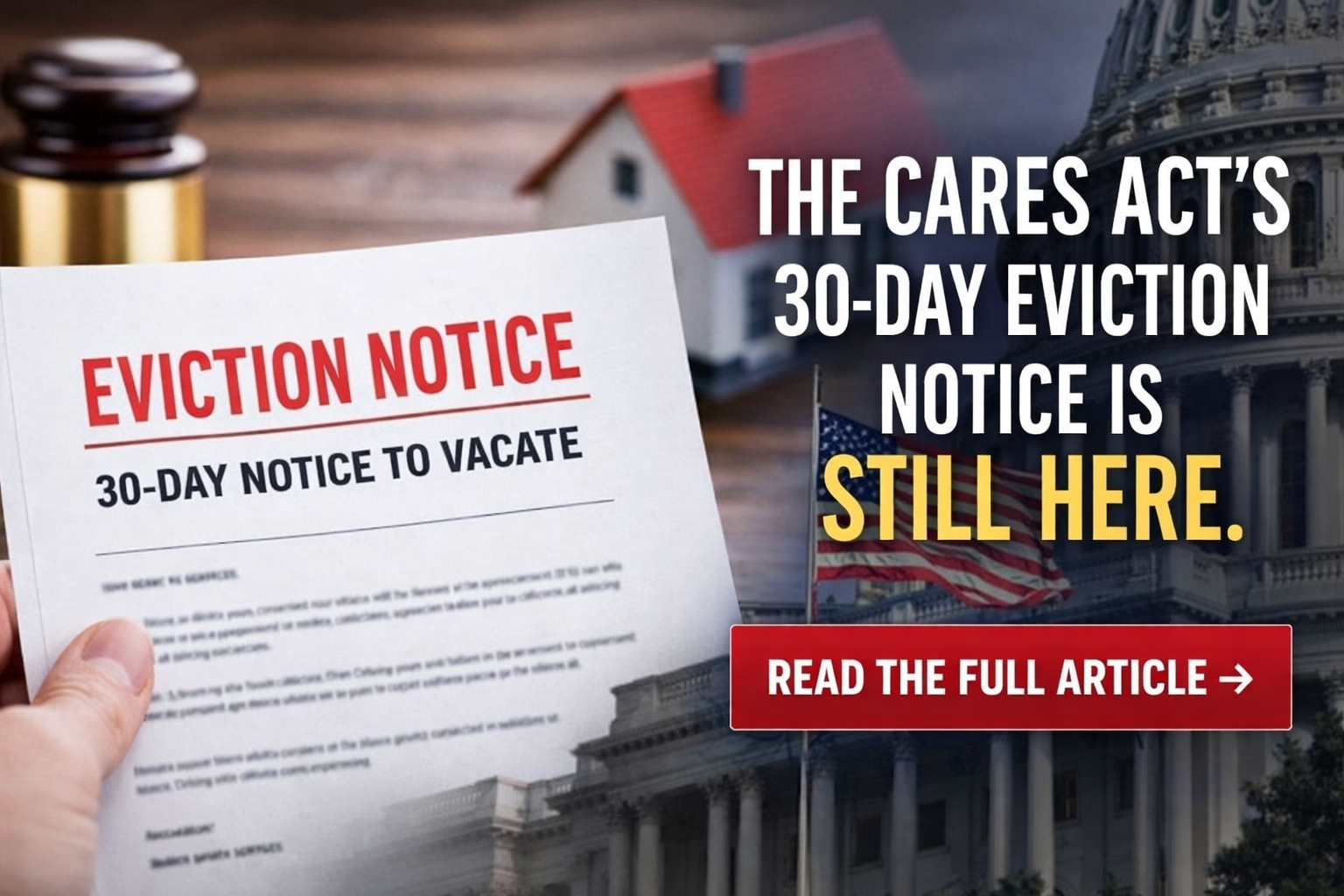
Section 4024 of the CARES Act requires landlords of “covered properties” to provide tenants with at least 30 days’ written notice to vacate before filing an eviction for nonpayment of rent.
Importantly, this requirement:
- Applies to properties with federally backed mortgages or federal housing subsidies
- Has no expiration date
- Has been upheld by multiple courts as an ongoing legal obligation
Estimates suggest that roughly one-quarter of all U.S. rental units fall into this “covered” category.
The Confusion: Federal Agencies Step Back
In 2025 and 2026, several major federal agencies began rolling back enforcement mechanisms tied to the 30-day notice rule.
For example:
- Fannie Mae and Freddie Mac announced they would no longer enforce compliance through loan requirements or audits.
- The U.S. Department of Housing and Urban Development (HUD) rescinded its own regulatory rule requiring a 30-day notice in public housing and voucher programs.
HUD’s February 2026 rule explicitly reverted notice requirements back to pre-pandemic standards, often allowing shorter timelines governed by state law.
At first glance, these actions appear to signal the end of the 30-day requirement.
But that conclusion would be incorrect.
The Critical Reality: The Law Still Exists
Here’s the key distinction many landlords miss:
- Federal agencies can change regulations and enforcement policies
- They cannot repeal a federal statute
And the CARES Act is still federal law.
Legal analysts and practitioners consistently emphasize this point. As one housing law firm noted, “HUD can withdraw its own regulations but cannot repeal a law passed by Congress.”
Another advisory warns plainly:
“The CARES Act is still the current federal law… courts can still dismiss your eviction” if the 30-day notice is not properly given.
In practical terms:
- The enforcement pressure has been reduced
- But the legal risk remains
That means tenants—and increasingly, tenant attorneys—can still raise CARES Act compliance as a defense in eviction proceedings.
The Industry Response: A Push to End It
This legal gray area has sparked a growing backlash from landlord and housing industry groups.
Organizations such as the National Apartment Association and the National Association of REALTORS® have publicly advocated for:
- Complete elimination of the 30-day requirement
- Passage of federal legislation to return eviction law fully to the states
- An end to what they describe as a “lingering pandemic policy”
According to one industry report, continued enforcement of the rule has:
- “contributed to financial loss for housing providers”
- delayed eviction proceedings
- created inconsistent outcomes in courts
Some advocacy statements go further, arguing that the rule was “intended to be temporary” and is now being applied beyond its original purpose.
This is the context behind alerts and campaigns urging policymakers to “stop federal enforcement.”
Real-World Impact: A Legal Trap for Landlords
For landlords—especially smaller operators—the situation creates a dangerous compliance trap.
In many states, including Florida:
- Standard eviction notices for nonpayment may be as short as 3 days
- But if the property is CARES-covered, 30 days is required instead
Failing to recognize that distinction can result in:
- Case dismissals
- Restarting the eviction process
- Additional financial losses
Even more problematic, determining whether a property is “covered” is not always straightforward. It may depend on:
- Mortgage backing (Fannie Mae, Freddie Mac, FHA, VA)
- Participation in federal housing programs
- Historical financing structures
Where Things Stand Now
As of 2026, the situation can be summarized as follows:
- The CARES Act 30-day notice requirement still exists in federal law
- Federal agencies have reduced or eliminated enforcement mechanisms
- Courts may still require compliance in applicable cases
- Industry groups are actively pushing for full repeal
In other words, the rule is no longer being aggressively enforced at the federal level—but it remains very much alive in the courtroom.
Bottom Line
The current environment is not one of clarity—it is one of transition and uncertainty.
For landlords, the safest course remains:
- Determine whether your property is CARES-covered
- Use a 30-day notice when required
- Avoid assuming that federal rollbacks mean the rule is gone
Until Congress acts to repeal or amend the statute, the CARES Act’s 30-day notice requirement continues to operate as a quiet—but powerful—factor in eviction law.
And for now, that means one thing: Ignore it at your own risk.